Ho Chi Minh City–Can Gio Urban Railway Moves One Step Forward with Geological Surveys at 10 Locations
By Axen Property Vietnam
The urban railway connecting central Ho Chi Minh City with Can Gio is entering another important stage of technical preparation. Following Vingroup’s geological survey proposal in late May 2025, Ho Chi Minh City authorities granted permission to conduct geological drilling at several locations across the southern part of the city and Can Gio District.
The surveys are intended to collect data on soil composition, geological characteristics, and technical conditions along the proposed route. These findings will provide an important basis for consultants to develop design solutions, select suitable structural systems, and evaluate factors relating to safety, construction costs, and project implementation timelines.
Geological surveys along Nguyen Van Linh, Nguyen Luong Bang, and Rung Sac roads
According to the Ho Chi Minh City Department of Construction, geological drilling will be carried out at a total of 10 locations.
These include:
Seven survey locations along Rung Sac Road in Can Gio.
Two locations along Nguyen Luong Bang Street.
One location along Nguyen Van Linh Boulevard.
The concentration of survey sites along Rung Sac Road indicates that the geological and ground conditions in Can Gio require particularly careful assessment.
The area has natural characteristics that differ significantly from those of central urban districts, including extensive waterways, soft soil conditions, and a distinctive ecological environment. Therefore, field survey data will play an important role in determining foundation solutions, elevated railway structures, and other technical components of the project.
Construction at each drilling location must not exceed six days. Contractors are required to install adequate signage, warning lights, traffic-control personnel, and other safety measures around the construction areas.
Once the surveys are completed, roads and pavements must be restored to their original condition, ensuring that the surfaces remain level, clean, and free from any long-term disruption to local traffic.
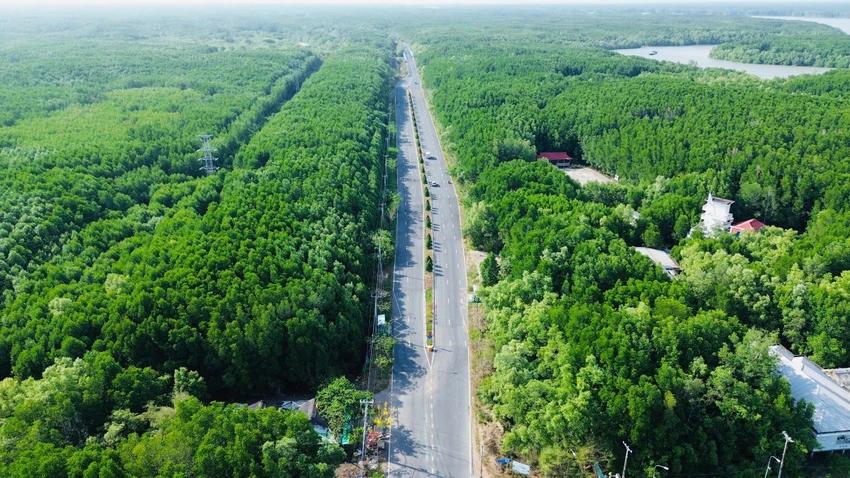
Chú thích ảnh (EN): Rung Sac Road in Can Gio, one of the areas surveyed for the proposed Ho Chi Minh City–Can Gio urban railway. Photo: Dao Trang/PLO.
From a survey proposal to on-site implementation
In May 2025, Vingroup submitted a written proposal to the Ho Chi Minh City People’s Committee, the Department of Construction, and relevant local authorities, requesting permission to conduct geological drilling for the design of the Ho Chi Minh City–Can Gio urban railway.
Under the initial proposal, the surveys would be conducted at several locations along urban roads and within the Rung Sac area. The work would be undertaken by the Center for Engineering Geological Research under the University of Mining and Geology, with an expected implementation period of approximately 60 days.
The investor also committed to complying with regulations on public security, environmental protection, and the restoration of roads and pavements after the surveys were completed.
The granting of survey permits following the investor’s proposal indicates that the project is gradually moving from the conceptual research stage toward the collection of technical data in the field.
However, geological surveying remains only one of the initial steps in the investment preparation process. The findings must still be used to complete the proposed design, estimate total investment costs, assess environmental impacts, and carry out the necessary legal procedures before construction can officially begin.
Proposed route of approximately 48.5 kilometres
Under the proposal submitted by the investor, the Ho Chi Minh City–Can Gio urban railway would extend for approximately 48.5 kilometres, connecting the city centre with Can Gio District.
The investor proposed beginning project preparations in 2025. Construction is expected to take place between 2026 and 2028, followed by trial operations and project handover in 2028.
The Ho Chi Minh City People’s Committee assigned Vingroup to study and prepare the project proposal. The Department of Construction was tasked with coordinating with the Department of Finance and other relevant agencies to examine the procedures required for implementation under a public-private partnership model.
These dates currently remain part of the investor’s proposed schedule. The actual timeline will depend on the appraisal process, selection of the investment structure, completion of legal procedures, capital arrangements, and the resolution of any technical issues that may arise.
Why are geological surveys important?
For a railway project extending over dozens of kilometres, geological surveys serve purposes beyond identifying suitable foundation locations.
The findings also help technical teams to:
Determine the depth and load-bearing capacity of different soil layers.
Assess the risk of subsidence and ground deformation.
Select appropriate foundation and structural solutions.
Estimate construction costs based on actual site conditions.
Reduce technical risks during construction and operation.
This is particularly important because the proposed route would pass through southern Ho Chi Minh City and continue toward Can Gio, where soft ground conditions and environmentally sensitive ecosystems are common. Without sufficient geological data, the project could face design revisions, rising costs, or prolonged construction schedules.
The surveys at 10 locations can therefore be regarded as an initial step in collecting the baseline data required to assess the technical feasibility of the proposed route.
Expectations for a new southern transport corridor
At present, travel between central Ho Chi Minh City and Can Gio primarily depends on the road network and the Binh Khanh ferry. Travel distances remain relatively long, while accessibility is affected by traffic conditions and the limited capacity of existing infrastructure.
Once completed, the urban railway could introduce a high-capacity public transport option, shorten travel times, and strengthen connectivity between Can Gio and central Ho Chi Minh City.
The project could also support the development of areas situated along the proposed corridor, including South Saigon, Nguyen Van Linh Boulevard, Nguyen Luong Bang Street, and Can Gio.
However, the railway’s impact on the real estate market would not be distributed equally across all locations. The level of benefit would depend on station locations, accessibility, actual project progress, land-use planning, and connections with other transport infrastructure.
Investors should therefore avoid making decisions based solely on survey activities or proposed timelines. Important factors that still require monitoring include the official route alignment, station locations, investment structure, total project cost, and formal project approval.
A notable step forward, with many procedures still ahead
The granting of permits for geological drilling indicates that the Ho Chi Minh City–Can Gio railway is seeing more concrete technical progress.
Nevertheless, this does not represent a decision to begin construction. Several stages remain between geological surveying and actual implementation, including the preparation and appraisal of the feasibility study, approval of the investment plan, environmental impact assessments, and completion of other related procedures.
In the coming period, the survey findings, official design proposal, and confirmed route alignment will be important factors in determining the project’s feasibility and assessing its potential impact on Ho Chi Minh City’s transport network and the development of the city’s southern region.
Information sources: Phap Luat Ho Chi Minh City Newspaper and the Ho Chi Minh City Department of Construction. Image credit: Dao Trang/PLO.